On the Water Decisions for Summer Walleyes

Steve Pennaz, summer walleyes on Lake of the Woods

It’s July.  Surface water temps in areas on Lake of the Woods have reached 80 degrees. The mayfly hatch has taken place.  Spinners and crawlers are the go to method.  Some anglers are adding downriggers to their boats.  Crankbaits are picking up steam.  It happens every year, the walleyes are kicking into summer mode.  There is a lot of life taking place below the water surface.  To capitalize as an angler, it is important to make good on the water decisions for summer walleyes.

Lake of the Woods summer walleyes are being caught many ways, in many spots and in many depths.  A recent day on the water was a great illustration of how to make decisions that lead to more summer walleyes.

Different schools of walleyes doing different things.  Some are in the shallows being opportunistic with that part of the ecosystem.  Others walleyes are hanging out in deep water basins or adjacent to deep water structure. Some are living in that 15′ of water in Little Traverse Bay which is the area north of Garden Island.  Others are taking advantage of that deep water aquarium full of forage called Big Traverse Bay which is the big open water south of Garden Island. Walleye Lake of the Woods

There are many forms of forage in the lake to feed on, one of the reasons Lake of the Woods is so healthy.  Walleyes are feasting on mayfly larvae, perch minnows, perch, young of the year walleyes, tulibees, crayfish, blood worms, etc.  This variety of forage is also why one group of anglers will fill a cooler in less than 10 feet of water and others will be targeting fish in that 30 – 34′ range and also filling their cooler.

Adapting while on the water is an important skill for anglers.  For example, this week we fished a reef that very recently some friends fished with great success.  Upon arriving, we noticed the amount of bug hatches on top of the water.  For a long ways, you would see mayfly carcasses.  In some areas, the small black flys were around (bug spray on legs and ankles took care of the issue quickly).

In looking at the sonar, there was a ton of bait and summer walleyes suspended about 15 – 20 down in about 30′ of water.  When I say the screen was loaded, it was loaded.  Not a good sign typically on Lake of the Woods.  From experience, it is hard to get these suspended fish to eat.  We believe they had one thing on their minds, mayfly larvae.  We still fished that area hard with just a couple of fish.

Rather than beating ourselves up, we switched spots to another reef we knew there were big fish hanging around.  Some of these fish were on the bottom.  They show up as big arches or “hooks” on the sonar on or adjacent to the bottom.  Just what we wanted to see.  Again, these fish were uncooperative.  We pulled spinners and crawlers through a number of fish with no success.  We switched over to crankbaits, again no success.

Cleaning summer walleyes, Lake of the Woods MN Rather that beating a dead horse, there is so much water, so many spots to fish that we moved on.  In this case, we decided to do a “milk run”.  Let’s quickly and efficiently work a number of spots until we can get something rolling, and we did.

We stopped on the edge of a deep underwater point.  We worked it from 26′ down to 6′.  A couple of saugers.  After a short time, we pulled the plug and hit another spot.

This spot was the right spot but small.  It had a couple of charter boats on it who were doing well.  Rather than crowding them, we decided to move away from them and at about 5mph, watch our sonar.  In a different area we started seeing signs of life.  After the screen looked healthy, even though we didn’t plan on fishing this exact area, we decided to give these fish a try.  Why?  We trusted our electronics.

After about five minutes, we had a nice 16 inch walleye in the boat.  Soon another and another.  Summer walleyes in this spot cooperated nicely.  With no boats around, we were on active fish.  After catching all the fish we needed and the live well healthy, we decided to go looking for big fish (just for fun).

We pulled a deep water spot and fished it for 30.  We could see some sleds but no takers.  Other boats were not swinging nets.  Time to move on.

Fishing memories, there was a shallow water spot were were basically going right by to get to a big fish deep water spot.  I talked my partner into giving the shallow water 20 minutes.  “Either they are there or they are not,” I said as I was very curious about the spot as I had good memories there. Spinner blades for Lake of the Woods MN Walleyes

After about 10 minutes and in 7′ of water, we hooked into a 24 incher.  We went on to catch eaters, some larger walleyes, nothing huge but a few fish between 22-24″.  A good move.  A fun and healthy spot.

We continued on to on last deep water spot that I know for big summer walleyes.  Lots of hooks.  Lots of suspended hooks, some on the bottom.  Worth a pull.  Right away, a 25 incher decided to commit.  A nice fat fish.  We thought this was going to be good.  I missed a fish shortly after.  We fished this spot for an hour making circles around the spot we had action right away.  Nothing.  No bites, no fish.  Crazy, but that is fishing.

Overall, a wonderful and memorable day of fishing.  If we wouldn’t have done a milk run, I anticipate we would have caught a few fish.  By looking for the right scenario with summer walleyes willing to eat our offerings, our day turned into one that makes Lake of the Woods famous.  What a fishery!


Access the Lake of the Woods Tourism Website

Access resorts, hotels, guides and charter boats on and around Lake of the Woods for Summer Walleyes


Boating to the NW Angle

Boating through Lighthouse Gap, Lake of the Woods MN

Traveling to the NW Angle can be done a number of ways.  Lake of the Woods is a big lake.  Across the water from the south shore up to the NW Angle, it is a 35-40 mile trip depending upon where you depart.  In the open water months, there are typically three ways to travel up.  Some prefer driving up which includes a short stretch through Canada.  Some actually fly up via float plane.  And finally  some prefer boating across the lake.

As long as the U.S. / Canada border is closed, flying up via float plane or boating across are the two options available.  As most don’t have access to a float plane, boating across is the most realistic for many.  Traveling to the NW Angle across Lake of the Woods can be a fun experience but it is vital to know your options and have a game plan that includes “safety first” as one of the criteria.

The first question it is good to ask is, “What are all of our options in traveling to the NW Angle during the border shutdown?”  A first good step is to contact your favorite NW Angle resort.  In some cases, they can pick your group up or help you arrange travel across.  There are many options.  Like anything, it’s safety first.

One option is to use the Lake of the Woods Passenger Service.  The passenger service boats people across the lake on a big, comfortable charter boat.  Many who use a guide or rent a boat up at a NW Angle resort are taking advantage of this option this year anyway as to get their NW Angle vacation in. traveling to the NW Angle

Another option when boating across is to put your people and gear aboard a charter boat and follow behind the charter in your own boat.  This not only can make the ride much more comfortable for passengers but also lightens the load of your own boat making it more seaworthy.  It also helps that a big charter boat is handling the navigation and breaking down the waves for you across the lake.

There are some guides up at the Angle who are planning on picking up guests on the south end, weather depending which makes traveling to the NW Angle that much easier.  Communicate with your resort for all of the options.

NW Angle, MN Lake of the Woods Considerations if boating across on your own.  Traveling across on your own can be a very viable option or a “not so good” of option depending upon a number of things.  Here are a few considerations.

  1.  Is your boat seaworthy enough to cross 35 miles of big water?
  2. How reliable is your motor?
  3. How experienced is the captain?
  4. Do you have flexibility in your schedule if weather is not good?
  5. How seaworthy are your passengers on the boat?
  6. Do you have reliable electronics and do you know how to use them?
  7. is your bilge pump working?

Safety Equipment and considerations.  northernmost point buoy

  1. Is everyone wearing an approved personal flotation device (PFD)
  2. Have you checked all necessary safety equipment?  (Fire extinguisher, throw cushion, marine band radio, cell phone with portable battery charger, flares, whistle, etc)
  3. Do you navigation lights work?  Do you have a spotlight or bright flashlight?
  4. Have you contacted the resort or people at your final destination and communicated your travel plans?
  5. Have you mapped out your route?
  6. Where are you going to put in and depart from?
  7. Have you lightened up your load for the boat to be safe?
  8. Is your gear in waterproof bags or containers?
  9. Do you have Navionics on your phone as a backup for navigation?
  10. Have you checked the weather forecast?

Wheeler's Point Public Access, Lake of the Woods, Rainy River Where can I launch and park my truck and trailer?  There are a number of resorts who have graciously offered to allow you to park your truck and trailer at their resort if you are boating up to a NW Angle resort.  It is a good idea to contact these resorts and communicate your plans to make sure you know where to launch your boat and where they would like you to park your vehicle.

South Shore Parking Options…

Arnesen’s Rocky Point.  Located on the SW corner of the lake, Arnesen’s has a new harbor, a boat ramp and plenty of land for parking your rig.

Wigwam Resort.  Located on Wheeler’s Point, Wigwam is a couple of blocks away from the Wheeler’s Point public access.

Border View Lodge.  Border View Lodge is also located in the Wheeler’s Point area and is right next to the Wheeler’s Point public access.

Boating to the NW Angle is a very special experience.  This year for many, the normal way to travel up is going to be different.  Once there, the few extra hurdles will be well worth it.  With that being said, we all have to error on safety first.  If you have any questions on traveling across the lake, we encourage you to contact your favorite resort or you can certainly contact us at Lake of the Woods Tourism as well.  Have fun, enjoy the adventure, be safe.


Access the Lake of the Woods Tourism website

Access Lodging Options on and around Lake of the Woods

Black Bears Around Lake of the Woods

Black bear, Lake of the Woods

Wildlife is abundant in Lake of the Woods, well part of our title is woods after-all. Black Bears are one of the many majestic creatures to be roaming our lands. An estimated 12,000 – 15,00 reside in Minnesota. Acres and acres of forested land from the South Shore to the NW Angle allow for bears t Black Bear by rock o call home. Hopefully on your next trip you will catch a glimpse of one!

Black bears are omnivorous meaning they eats both plants and meats. This ranges from fruits, nuts, and honey to fish, ants, and sometimes even your garbage. They are extremely adaptable though they primarily will reside in high forested areas with ground vegetation. You may see them scrounging in an open field occasionally. They will travel 15-80 miles, usually returning to their summer home each year. They are typically solitary animals unless you catch a mama with her cubs.

Females give birth to up to 6 (most commonly 2-3) cubs. They will hibernate for up to 6 or 7 months in the winter and give birth during this time. Newborn cubs will not hibe Mama bear and two cubs-1 (2) rnate but will stay with mom until venturing out usually early April depending on weather. Dens can consist of anything from a hole in a tree trunk, to a cave, or a brush pile. Cubs will stay with their mom for a year and a half and hibernate that year with their mom, though they are weaned after 7-8 months.

Black Bear on hind legs, Lake of the Woods

Black bears are prevalent around the lake.  You might see them crossing the road, in a field or swimming between islands.  They are a true sign you are up north and amongst nature.  Here is a black bear a resort caught on video while they were fishing.  It is not uncommon for visitors to see bears swimming between islands or while traveling some of the back roads while on a scenic drive in the area.

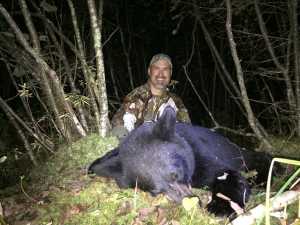
Bear Hunting.  TheMN DNR allows bear hunting in Minnesota.  Numbers are watched closely to manage a healthy population of bears.  Last year in area 12, the area around Lake of the Woods, 700 people applied for a bear hunting permit.  Out of 700 applications, 125 permits were granted.  The average success rate in Minnesota for bear hunting is 20-25%.  Last year in Lake of the Woods, the success rate was 43%!

Hunters coming to Lake of the Woods enjoy literally hundreds of thousands of acres of public hunting land as well as a strong population of bears.  Black Bear Hunting, Lake of the Woods

Not considered dangerous, all wild animals need their space and respect.  We encourage you to enjoy the area black bears from a safe distance!

***

To learn more about Lake of the Woods, check out the Lake of the Woods Tourism website.

To find a guide, charter boat or lodging, check out our lodging page.

Don’t Forget about Sophia’s Law

Sophia's Law

Sophia Baechler Are you aware of Sophia’s Law?  This law that took effect in the State of MN May 1, 2018 to address the potential dangers of carbon monoxide in enclosed occupancy compartments.  It is important boaters are aware of carbon monoxide as well as the not so much talked about law.

Minnesota is the first state in the nation to require carbon monoxide detectors and warning stickers on certain boats. Sophia’s Law, named after 7-year-old Sophia Baechler, who died tragically from carbon monoxide poisoning while on her family’s boat, took effect May 1. 

Carbon monoxide is a hidden danger as the deadly gas is odorless, invisible and closely mimics signs of intoxication or seasickness. Even at low levels, carbon monoxide can be lethal.

Under the law, functioning, marine-grade carbon monoxide detectors must be installed in recreational motorboats with a designated sleeping accommodation, a galley area with a sink, and a toilet compartment. For all gasoline-powered motorboats with an enclosed occupancy compartment, three carbon monoxide warning stickers are required. The stickers must be attached at the helm, the enclosed occupancy space and the stern.

Motorboats, regardless of fuel type, must have a functioning marine CO detector if they have an enclosed accommodation compartment, which is defined as a motorboat with all of the following:

  1. Designated sleeping accommodations
  2. A galley area with a sink
  3. A head (toilet) compartment

Enclosed occupancy compartment is defined as:
One contiguous space surrounded by boat structure that may be occupied by a person

If your boat just has an occupancy compartment you are not required by law to have a CO detector in the space, however, it is highly recommended for the safety of all passengers that a detector be placed in any enclosed compartment.

A detector shall be located to monitor the atmosphere in the main cabin and each sleeping area per the American Boat and Yacht Council A-24 Standard. Supplementing with additional low level CO monitors will alert passengers sooner of the presence of carbon monoxide which can be harmful at low levels/under 30ppm.

A detector is not required in head (toilet) compartments or in sleeping areas separated by open or non-permanent structure.

Sophia's Law stickers Warning stickers and information about the dangers of carbon monoxide while boating were mailed to registered boat owners in the spring of 2017. Stickers also can be found at all Minnesota deputy registrars and many marinas and marine dealers.

Qualified marine carbon monoxide detectors must have the words “Marine Carbon Monoxide Detector” on the detector or on the product literature.

Marine CO detectors must meet ABYC standard A-24 , July 2015 which specifies that detectors must be listed for marine use, including certification by an independent party.  Marine Carbon monoxide detector

In a quick search, marine CO detectors are available with a 7 year battery for under $100.

There have been many instances when carbon monoxide has been the cause of some very harrowing or in some cases, fatal episodes on the water, including Lake of the Woods.  For some, a law like Sophia’s Law may seem like one more regulation for boaters.  In reality, it will absolutely save lives.  You know what they say about an ounce of prevention.

Boating and fishing go hand in hand.  When out on the water this year, make sure you are as safe as possible but this year, legal as well.


Click Here to view a list of Lake of the Woods lodging.

Click Here to view Lake of the Woods Tourism

Spots Open for the MTT Walleye Tournament on Lake of the Woods

MTT, Lake of the Woods

It’s that time of the year again when the MN Tournament Trail (MTT) comes up to Lake of the Woods.  The very well run walleye tournament is held out of Border View Lodge which is well positioned right next to the Wheeler’s Point public access at the mouth of the Rainy River.  The tournament is a 2 person team format and is open to the public.  With the health of the fishery and strong numbers of big fish, this will be a fun one! Lake of the Woods- Minnesota Tournament Trail

The dates of the MN Tournament Trail on LOW are July 10 and July 11.  Each day is it’s own tournament and and this year the MTT is using the PRT (Photo, Release Tournament) format.

This is a fun format.  Basically, each team will receive an official MTT measuring stick and SD card the morning of the tournament upon boat inspection.  Because this is a release tournament, every walleye, even though it might be within the slot of 19.5″ – 28″ which have to be released on Lake of the Woods, they can take a couple of pictures of it, release it and it counts for points.  So rather than fishing for walleyes just under that 19.5″, anglers are fishing for the largest fish in the lake, even if they are in the slot.

Basically, when a MN Tournament Trail team catches a walleye, they have to take two images.  One image will be the walleye on the registered ruler.  Of course, check official rules, but one angler will place the walleye on the bump board (ruler) with it’s head to the left and belly of the fish facing the angler holding the fish.  Hands of the angler need to be away from the head and tail to show the fish is touching and where the tail measures.  The angler with the camera takes one picture of the walleye on the official ruler and a second “hero” shot, a picture of the fish being held to the camera.  This second shot shows the markings of a walleye ensuring the same fish cannot be used twice.

It is important for anglers to double check images for clarity, shadows and any other faux pas before releasing the fish back.  Once anglers handle and take picture of a couple of walleyes, it’s easy.  It also really feels good to get credit for a nice walleye just under 28″, being able to release fish healthy back into the lake and not have to pay attention to fish in the livewell.

The video below gives a nice idea on how the PRT works.  The MTT implemented this format in 2015 initially on Mille Lacs Lake as it was catch and release only.  In 2020 partly due to COVID – 19 and social distancing protocols, PRT is now being used on all MTT tournaments this year.  It has been utilized on LOW in past years with success.


https://www.youtube.com/watch?time_continue=40&v=7CZjX6YILn4

Tournaments offer anglers the opportunity to competitively fish for walleyes.  There are a variety of teams that fish including friends, couples, and father/son and so on.  If you haven’t tried a tournament, the MTT is a nice way to dip your big toe in the water.  It is quite reasonable to enter, $220 per team per tournament day.

Events, MTT, Lake of the Woods Fishing a tournament forces anglers to think while on the water.  Changing weather conditions, fish that moved, fishing over fish that are not biting.  All of these scenarios require making decisions.  It is a south wind, should we set up outside the Lighthouse Gap and see if fish are loading up this morning?  It is a strong north wind, should we travel all the way to Garden Island or fish our fish closer to home base?  The wind died, do we still try our shallow spots or focus on deeper spots?

As they have done in the past, the MTT will also host it’s championship tournament on Lake of the Woods September 17 and 18, 2020.

If you are interested in fishing Lake of the Woods in a tournament, this is a great one.  There are a number of lodging options available in the area.  Mike Holt is the tournament director and between he and his wife Renee run a great tournament.  To find out more about fishing the MTT or to register, go to www.mntournamenttrail.com or call 320-679-2825.


To learn more about Lake of the Woods, check out the Lake of the Woods Tourism website.

To find a guide, charter boat or lodging, check out our lodging page.

Smallmouth Bass Overlooked on Lake of the Woods and the Rainy River

smallmouth bass, NW Angle, Lake of the Woods

If there is a gamefish in Lake of the Woods that receives very little respect, it is the smallies that inhabit the waters in good numbers, more formally known as the smallmouth bass.  These hard fighting fish that rip drag and burst out the water without notice are in big numbers throughout the Rainy River, Big Traverse Bay and of course, the NW Angle and islands area of LOW.

Where do smallmouth bass live in this diverse body of water?  First, let’s talk the Rainy River.  With over 40 miles of navigable and fishable water from the mouth of the Rainy River up to about the Birchdale access (and even further if you know how to navigate the Manitou Rapids by boat), bass are prevalent in many spots.  Rocky areas, bridges, bays, current seams and tributaries to the river are great places to start.

Smallmouth bass offer some great shore fishing opportunities.  Try the Clementson Rapids, where the Rapid River dumps into the Rainy River and the Franz Jevne access, which are both east of Baudette.

clementson-rapids-300x225 clementson-rapids-2-300x225 DSC_0020

In addition to the river, Four Mile Bay is a huge area with edges of the river channel, rock, reeds and areas off of the main river current that is home to a lot of forage for big bass.  Locals have known for years the good numbers of bass in the big bay. Map of 4 Mile Bay, Lake of the Woods

The main basin called Big Traverse Bay holds good numbers of bass.  Target rock reefs and island areas.  Most of the bass are caught in depths less than 20′.  There are a lot of smallmouth bass caught on Lake of the Woods accidentally by walleye anglers.  The majority of these fish are hanging around structure, typically rocky areas.  The numbers are great and many of them turn into footballs, I mean really big bass. Map of smallmouth structure, Big Traverse Bay, Lake of the Woods

Up at the NW Angle is where the 14,552 islands of the lake begin.  Literally every island has habitat attractive to smallies.  Rocky points, scattered boulders and bays are good areas to begin your focus.  There is over 65,000 miles of shoreline on Lake of the Woods, most of it holding bass.

Smallmouth-bass_Samantha_Sunset-Lodge-225x300 Joe Henry bass

There are many ways to catch smallmouth bass, but one technique that is effective in covering water until you find a good pod of fish is pitching crankbaits to shore.  On a recent trip in which we casted island shorelines with shallow diving cranks, two of us ended up with just less than a hundred fish. About 20 of those were pike, walleyes and muskies.  The rest, bass.

Other techniques are certainly accustomed to bass anglers.  Buzz baits, poppers, spinner baits, and tube jigs.  For the skilled bass angler, this is a very short list!

Interestingly enough, another walleye technique that produces good numbers of bass, and not intentionally, is trolling with crawler harnesses.  A bottom bouncer combined with a snelled spinner and night crawler is a nice search technique that catches almost everything, including smallies.

If you enjoy bass and want to have thousands of world class smallmouth bass spots to yourself, give Lake of the Woods and the Rainy River a try.  Just because walleyes get all of the attention doesn’t mean that is the only fish living in these productive waters!


Click Here to find out more about Lake of the Woods.

Click Here for a list of Lake of the Woods Resorts.

Master the Skill of Quickly and Effectively Releasing a Fish

Releasing walleye next to boat, Lake of the Woods MN
There is a very good population of big walleyes in Lake of the Woods and they are a blast to catch.  Because of the slot limit set up for sustainability of the walleyes in the lake stating all walleyes between 19.5 – 28 inches must be released, there is a lot of releasing going on.  Whether it is walleyes or other species of fish, big fish or little fish, if your intent is to release them, it’s important to better understand the steps that can be taken leading to the fishes best chance of survival.  Planning for and understanding how to take good care of these fish and releasing them in a timely manner greatly increases their chance of survival.
Releasing a walleye, Lake of the Woods MN Right off the bat, fish survival will be better in shallower depths of water and when water temps are colder.  Keep this in mind.  For instance, if you have a good walleye bite going in 36 feet of water in August, the mortality rate will be higher on release fish vs releasing those fish in 20′ of water or in colder water.  Consider catching a few and moving on to shallower depths.
The technique we use to catch fish also helps determine survival.  For instance, catching a fish on a jig typically means the fish is hooked in the mouth as you set the hook right away upon feeling the bite.  When using a live bait rig in which you have to let the fish “take it” for a bit, the chances of a fish getting the hook deep is higher.  When a fish has a hook that is deep, actually snipping the line off is the fishes best chance of survival vs doing surgery and ripping the hook out, regardless of how careful you are.
There are a number of tips to increase the odds of a fish surviving when releasing it.  A main tip is plan ahead.  Have your needle nose pliers, jaw spreader, measuring board and camera all ready to go to save time.  The quicker you can land the fish, take the fish out of the net, remove the hook, possible snap a couple of pictures and release the fish back into the water, the better.
It is important to understand how to properly hold a fish not only for properly releasing it but also to minimize cuts and getting stuck.  Small fish are less of a challenge than large fish.  Anglers will learn fairly quickly how to grab a perch or white bass and not get cut up by the sharp gill plates.  Sunfish anglers know the technique of smoothing back the top spiny fin.  And for those parts in which catfish and bullheads are popular, understanding how to navigate your hand around the two side and one top fins that have barbed spines in them is important.
On Lake of the Woods, the majority of releasing involves walleyes.  One way to hold a walleye is by the hard cartilage area in their gill area. Make sure you hold them by the tough cartilage that makes up their gill structure in their head area but do not actually touch the red gills in which they pull oxygen from the water to breathe.  Keep your fingers on the outside of their actual gills. Their actual gills are red and should not be touched or grabbed. Take two or three fingers and slide them along the outside of the gill area up into the tough cartilage of the walleye.  When using this technique on fish over 10 lbs, try and support their body weight by placing your second hand under their belly and holding them horizontally vs vertically.
Youtube video
Bass and crappies are typically held in the mouth as they don’t have sharp teeth and their mouths are inviting as they are big and easy to grab.
Pike and muskies are typically held within the hard cartilage of the gill area with one hand with the other hand supporting the body weight of the fish horizontally if it is a big fish.  In the old days, it was common for anglers to hold pike by the eyes.  This is frowned upon as it will blind the fish.
Lake sturgeon, well, these can be huge fish.  Consequently, it is important not to hold these fish vertically.  They are so heavy, internal organs and tissue can actually tear from their weight.  Remember, in nature, these fish swim and live horizontally in water.  Holding them vertically can simply be too much weight for their internal organs to handle.
It is also important to not hold sturgeon by the cartilage in their gills if they are too big.  It can actually be best to have one hand on their tale as it is firm and easy to grab with the other hand supporting the body weight of the fish under its belly and holding it horizontally.  If the fish is really big, it will take two people to cradle the fish!  If you don’t need to bring the fish in the boat, some anglers will pop the hook out while the fish is in the water next to the boat or even in a net if using a net large enough to hold a big sturgeon.  Rainy River Sturgeon, Lake of the Woods, Jamie Dietman
Really try not to drop fish or touch touch their eyes.  Dropping a fish can lead to obvious damage.  Touching their eyes can make them blind.  When releasing a fish, it is also important to try not to remove the slime from a fishes sides.  This is a protective coating against harmful parasites, etc to the fish.  As many of you know, a couple of fish with a lot of slime is a pike or a muskie.  Pike often carry the nickname, “slimer”, and for good reason.
When releasing the fish in the water, use more of a side by side motion vs forward and back to get water into it’s gills. Forward and back can actually drown a fish. Support the fish upright and slowly go back and forth until the fish makes the effort to swim on their own.  If the fish is tired out from a long fight and the process of being out of the water, it may take a few minutes.  Have patience, the fishes life depends upon it.
To find out more about fishing Lake of the Woods, check out www.LakeoftheWoodsMN.com
For a list of lodging options, check out www.LakeoftheWoodsMN.com/Lodging

Lake of the Woods MN Fishing Report 6.15.2020

Lake of the Woods Fishing Report 061520
On the south end… An incredible week of catching walleyes on Lake of the Woods. A few patterns this week. Some walleyes are shallow, 4-10′ of water being caught with crawler harnesses and crankbaits. Anglers are still anchored up on or near structure with a jig and frozen shiner or leech in 15-30′. Others drifting crawler harnesses in 23-28′ with good success. Gold / pink / orange / yellow / gold or combo of these colors still working well. Lots of eaters with larger slot and trophy walleyes being caught. Some big pike showing up in shallow water this week.
On the Rainy River… Smallmouth bass being caught around bridges and rocky areas. Pike are also active cruising in bays, bay mouths and current breaks. Walleyes hanging out in 15-25′ and being caught with a jig and minnow. The sturgeon “Keep” season opens July 1st. 1 per calendar year. Must be 45-50″ inclusive or over 75″.
Up at the NW Angle… Until the US / Canada border opens, guests can travel across the lake and stay in MN waters. Check with your favorite NW Angle resort for options.
Another great week of walleye fishing. Walleyes are caught pulling spinners with minnows or crawlers in 12-23′ of water. Jigging rocky points in 10 – 20 feet of water where fish are schooled is still effective. Pike, jumbo perch and smallmouth bass showing up as well. A complete list of lodging available at www.LakeoftheWoodsMN.com/Lodging

Rules To Package Fish for the Trip Home

Fish cleaning table of walleyes_Lake of the Woods

Each summer, thousands of anglers, families, and friends enjoy fishing Lake of the Woods.  Along with the traditional fish frys that are part of the trip, guests like to bring fish home as well.  The MN DNR has certain “Do’s and Don’ts” pertaining to properly packaging fish.  It is important to understand how to package fish for the trip home.

Fish cleaning table, Lake of the Woods With opportunity comes responsibility.  It us up to us as anglers to know and understand the rules of the MN DNR who manages natural resources in the state.  We thought it might be helpful to shed some light on what the rules are regarding cleaning, cooking and possessing fish while up at Lake of the Woods.

Over the years, one learns when discussing rules of any type to mention a disclaimer that our intent is to help with understanding and ultimately, it is your responsibility to know right from wrong.  The fish possession rules are not difficult, but one needs to be educated before hitting the water.  Resorts are a great resource for additional questions.

Individuals may not possess fillets in their boats or day/sleeper houses unless they are in immediate preparation of a meal or unless a licensed fish packer has filleted and packaged them to be consumed while their guests are on the lake and the fish packer is present with you and carcasses are available for inspection. Any filleting for transport should be done on shore or at the resort just prior to individuals traveling. For those who really like to dig into state law on how to package fish, click here for the link.

In a fish house or preparation for shore lunch.

State Rule 6262.0100 Subp. 5. (D) fish fry, Lake of the Woods

Subp. 5. Possession of fish while on state waters.

While on or fishing in state waters with size restrictions that differ from statewide regulations (which includes Lake of the Woods), including experimental waters, special management waters, boundary waters, or any other waters with size restrictions, all fish for which the different size restrictions apply must be undressed and measurable when in a person’s possession, regardless of where taken, except under the following conditions:

(1) when a watercraft is docked or moored to shore or when on the ice and a person is in the act of preparing and using the fish for a meal; or

(2) when a person is on an experimental or special management water and the fish were lawfully taken, have been packaged and labeled by a licensed fish packer, are to be prepared for a meal while on the ice or shore of that water body, and do not otherwise exceed the statewide possession limits.

Cooler of walleyes, Lake of the Woods When fish are consumed under subitem (1), the angler must maintain the carcass of a fish with size limits in such a way that the carcass may be readily unpacked, unwrapped, and separated so that the carcass may be examined, measured, and counted to ensure compliance with size restrictions for that day, as defined under Minnesota Statutes, section 645.45.

In a nutshell…

  1.  Lake of the Woods has a slot limit on walleyes and pike.  For walleyes, all fish between 19.5 inches and 28.0 inches must be released.  Anglers are allowed a combined limit of six walleyes / saugers, with up to four of the six being walleyes.  One walleye is allowed over 28 inches.  For pike, the daily limit is three fish.  The slot in which you must release fish is 30 – 40 inches long.  Anglers can keep pike under 30 inches or one over 40 inches per day.  In MN, the possession limit is equivalent of one day’s limit, consequently, anglers will enjoy a fish fry or two while up.

2.  If you are staying with a resort who has a fish packing license, the resort is allowed to clean and package fish without keeping them whole and without skin identification.  They will take care of what you need for traveling home with your filleted catch.

3.  When you clean fish on the water for a shore lunch (or in a fish house if ice fishing), you must keep the carcasses until the next day.  This allows a DNR Conservation Officer to count and properly measure fish.

Many folks enjoy having fish to bring home the day of departure.  Remember, saugers must be left intact with head, tail and fins for proper identification.  If a sauger isn’t properly cleaned for the trip home, it counts as a walleye.

As it says in the MN DNR Regulations on how to package fish…

How Do I Prepare Fish I have Caught for Transport?

-You must package and transport fish in a way that they can be readily unwrapped, separated, identified and counted.

-A fish may not be cut up into more than two filets.

MN DNR, package fish

-If you are transporting muskellunge, catfish, splake, or brook, brown or rainbow trout, you must transport them with the head and tail intact so the fish can be measured.

-Bullhead, sunfish and crappie may be filleted without leaving a patch of skin.

-Fillets from all other species must have a one inch square patch of skin with scales intact from a portion of the body other than the belly.

-Sauger without head and tail intact will be counted as walleye unless they are packaged by a licensed fish packer.

If you have further questions on regulations for cleaning fish and how to package fish, contact your resort, outfitter or the MN DNR.

Catching a bunch of fish, enjoying fish frys, and bringing some fish home is part of a fishing vacation for many.  This tradition has taken place for generations and folks still enjoy it to this day.  With that being said, it is important to understand how to properly package fish for the trip home.


Click here to return to the Lake of the Woods Tourism website.

Click here to view Lake of the Woods lodging options.

Summer Walleyes Can’t Resist Crawler Harnesses

Summer walleyes on crawler harnesses, Lake of the Woods MN

For many, a classic jig and a minnow is the go to presentation for summer walleyes on Lake of the Woods.  It could be argued that the jig and minnow has caught more walleyes out of the big lake than any other presentation.  It still is the go to and super effective.  However, there can be some very good arguments made in learning the nuances of pulling spinners for walleyes, also called crawler harnesses or simply snelled spinners with a crawler, minnow or leech can have big advantages.  The bottom line, summer walleyes can’t resist crawler harnesses.

Spinners for summer walleyes really kicks into gear as the water begins to warm up.  Normally when water starts to hit the mid 50’s, it is time to start considering drifting or trolling with spinners.

This video was not filmed this year but it has some good info about pulling crawler harnesses that is pertinent all of the time.  Check it out.

Youtube video

First off, a crawler harness and snelled spinner are basically the same thing.  When you are not using a night crawler, we don’t call is a crawler harness anymore, thus it’s a snelled spinner.  Semantics out of the way, these set ups are effective for summer walleyes.

Why are spinners for walleyes so effective?  A lot of reasons, the flash of the blade.  The different color combinations of the beads and blades.  The vibration of the spinner is sensed by the walleyes lateral line much like that of the prey they feed.  You can put crawlers, minnows, leeches and plastics on a harness.

My go to set up is a two ounce bottom bouncer with a harness between 4-6′ long.  It is conducive to use a longer snell in clearer waters, thus on Lake of the Woods, I normally go about 5′ or so as the water is stained.  In a nutshell, the key with this presentation is to slowly be pulling this through the water column where the fish are so the blade is spinning and a desirable speed the walleyes want that given day.

What that looks like is drifting or trolling your set up with a desirable 45 degree angle.  When I am trolling in my boat, my goal is 1.25 mph.  You don’t want the harness way behind the boat like when you are trolling with a crankbait.  You want that 45 degree angle and have total control.

Keep the sinker just off the bottom, not dragging the bottom, but rather touch the bottom once in a while to know you are down there and lift just off so you avoid snags and other debris.

When a walleye grabs it, it loads up like a wet sock.  Normally they don’t hammer it.  Simply lower you rod tip back at the same speed of the boat so the walleye doesn’t feel anything change for two seconds and swing the rod with a mild hookset.  Baitcaster rod in rod holder, Lake of the Woods

When using a crawler, I suggest a two hook harness and pinch off the crawler once hooked on the harness so only about 3-4″ of tail hangs off of the back hook.  This will avoid missing walleyes that grab the back of the rig.

This set up covers water.  It can be used from shallow to deep.  It will catch everything that swims.  And for the folks who go fishing with you less experienced, is a relatively easy way to get walleyes hooked up.

There are many good brands of snelled spinners or crawler harnesses you can purchase with length, fluorocarbon line and quick change clevices.  Some anglers like to tie their own crawler harnesses as well which allows creativity in the bead pattern, length of snell, etc.

Crawler harness, Lake of the WoodsGive spinners for summer walleyes a try this year, you might be surprised how many more fish end up in your boat!
 

Click Here to view a list of Lake of the Woods lodging.

Click Here to view Lake of the Woods Tourism