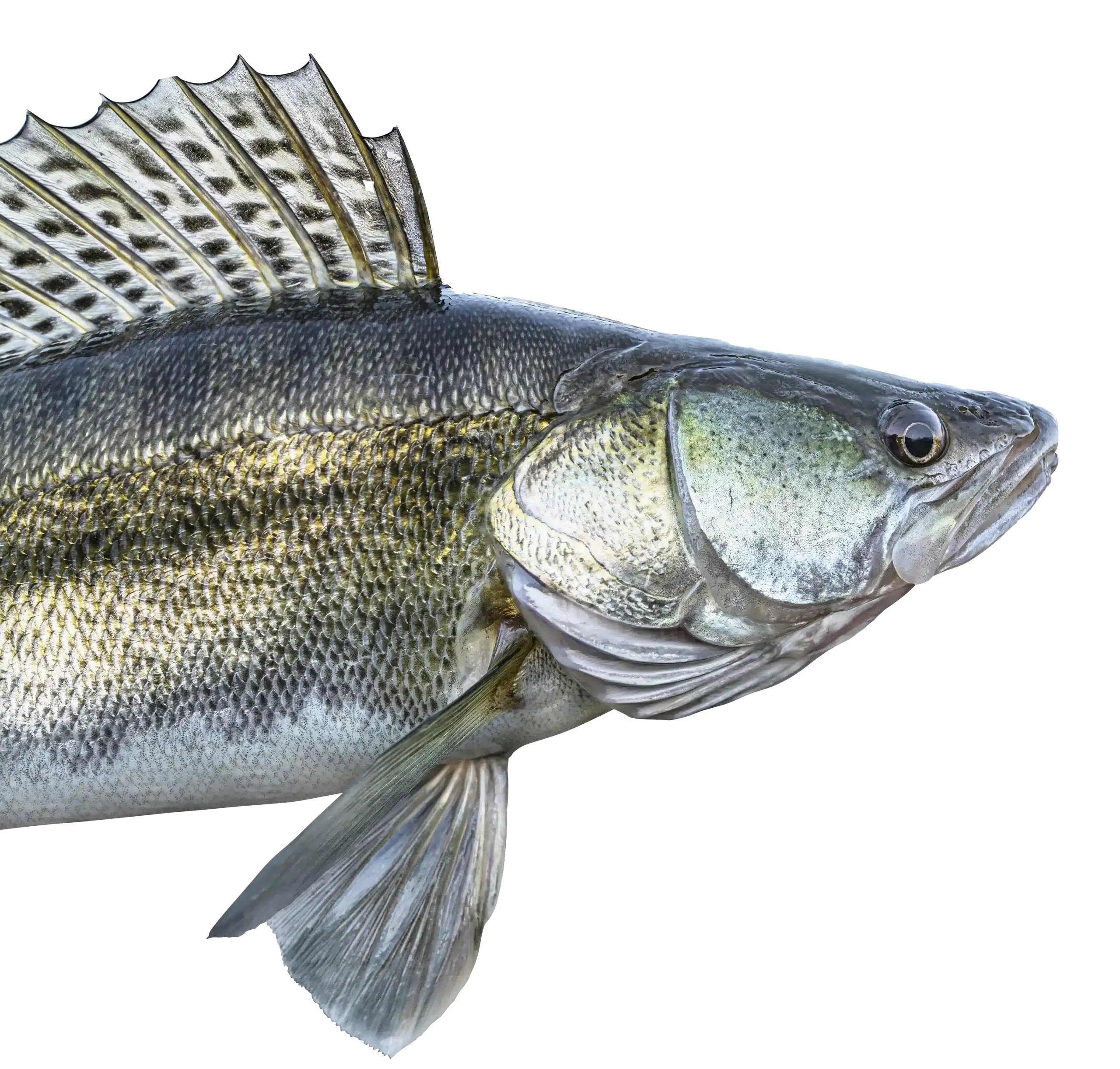
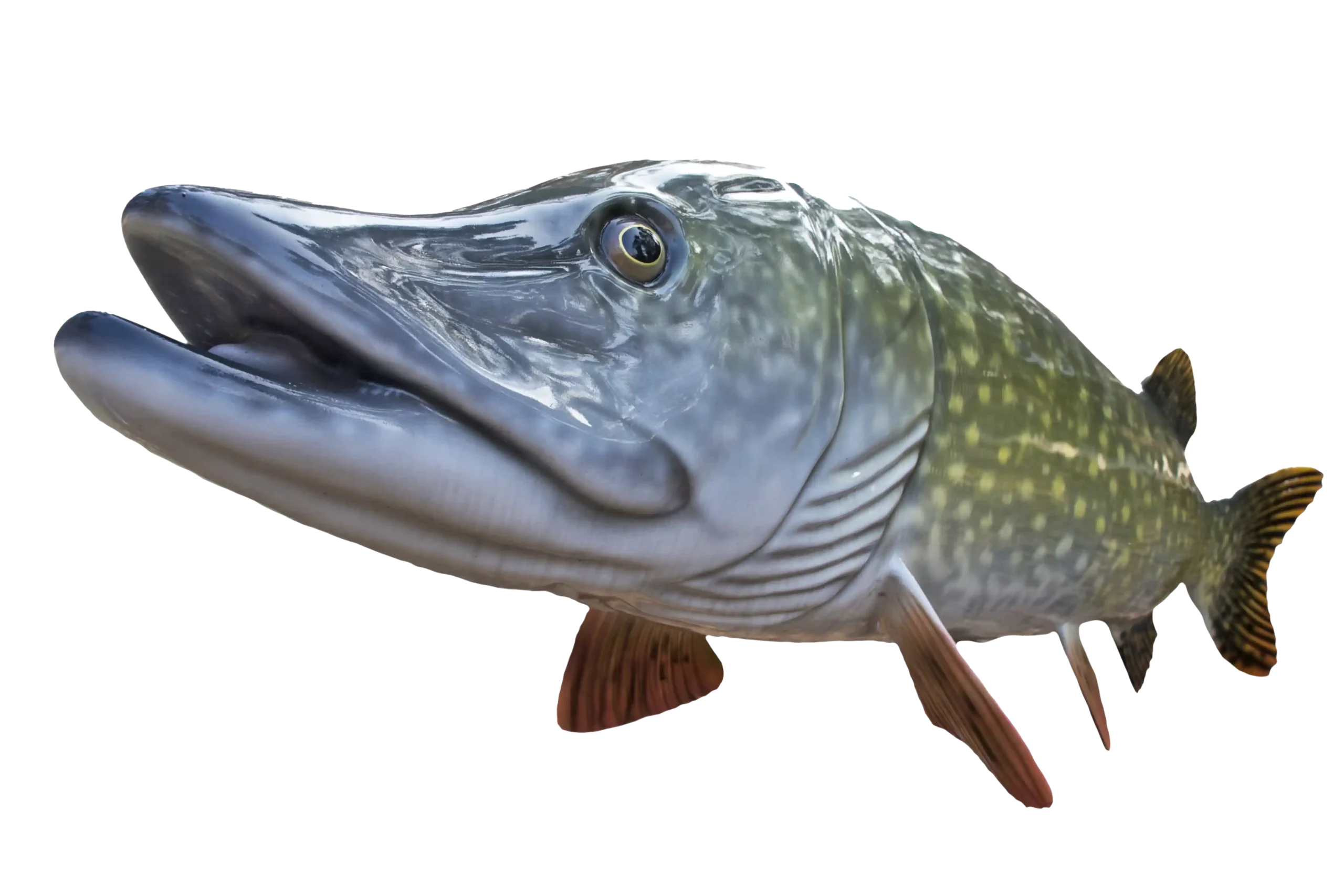
Lake of the Woods is a stained water lake. Natural tannins add a light brown color to the water. This makes it great for catching walleyes during the daylight hours. It also makes noise even more valuable. When it comes to catching walleyes and saugers through the ice on Lake of the Woods, sometimes it is the little things that can make a big difference. One of those “little things” I have noticed over the years is adding some noise and aggressiveness to my presentation can pay dividends.
Noise in the fishing world can come in a lot of forms. Pounding the bottom with your lure, the jigging action you create, rattles, vibration and spinners all create noise that can attract walleyes. One of the ways walleyes sense their next meal is through their lateral line. This lateral line senses vibration and noise in the water and can cause a natural triggering effect.
Over time, I have been turned on to using noise, becoming more aggressive with my approach in extracting walleyes and saugers from the icy depths across the ice belt. Some of this trial and error has been during times of a tough bite. Whether it is a cold front rolling through as they do periodically throughout the winter or perhaps a day in which the walleyes and saugers just aren’t feeding as well which could be for many reasons, noise has definitely been a strong tool in my walleye tool belt to catch more fish.
There are a couple of go to presentations / lures that I start with when I want walleyes to feel the noise. First, a vibrating lure with bb’s in it, such as a Rapala Rippin Rap. The second lure is a jigging spoon with rattles tipped with a minnow head or tail. There are certainly times when rattles will out fish a spoon without rattles and vice versa. As a rule, when I fish stained water lakes such as Lake of the Woods, I am a fan of rattles and a bit more noise.
For years, I was a fan of the lipless crankbaits for open water fishing, but had never used them through the ice. This technique first caught my eye when a local guide up at Lake of the Woods talked to me about how years back he used to use a Rattle Trap to ice March walleyes. Lake of the Woods has an extended ice fishing season with houses on the ice through March and the walleye season open through April 14th. Hence, anglers can target March walleyes putting on the pre-spawn feedbag.
He said he would be ripping a trap in one hole and deadsticking (a live minnow six inches to a foot off of the bottom) his second hole. He said there were times when a walleye would hit that trap so hard it almost rip the rod out of his hand.
I experimented a bit with lipless cranks through the ice but really started having success with the Rippin Rap. Now, it is a lure that I often lead with for my jigging line through the ice.
I experiment with jigging action, watching my electronics allowing them teach me what the walleyes want that day. Some days, the walleyes’ moods are consistent, wanting the same action for the lure. Other days, it is basically fishing each individual fish to learn what they want.
The normal jigging cadence I begin with is to pull the lure up in about two foot increments, enough to feel the vibration and hear the rattles. I then will let it free fall into the strike zone, which in my mind is normally about a foot off of the bottom.
I do mix the jigging up, giving extra long and fast rips at times, shaking the lure as fast as I can, elevating the lure in the water column as some bait is elevated and fish see up.
Sometimes walleyes will slide in slowly on the lure. Other times there will be a mark on my electronics out of nowhere. That fish will eat almost all of the time.
When a fish slides in slowly, I work various jigging cadences until I get that fish to go. Sometimes they want the normal jigging routine with a free fall. Other times, will hold it just above them a bit and jig it more subtly much like I would a jigging spoon with a minnow head. Jig, jig, hold in strike zone. Shake, shake, shake, shake, hold in strike zone. Walleyes will hit this lure sitting still and at times will actually prefer it sitting still in front of them verses moving.
When a walleye flies in out of nowhere, this fish is hot and is ready to eat. Normally, all I have to do is get the lure in front of them, give it a couple of shakes and POW! I have seen this happen often, both with walleyes when the bite is good but also when fish are in a more neutral mood. I think it relates to the reaction strike we talk about when pulling cranks in the summer.
It is important to let the fish tell you what they want each day. Their mood can change from day to day, sometimes, hour to hour. Regardless, don’t be afraid to add some noise to your walleye and sauger arsenal to ice more fish.
I’m writing this article with great excitement. I got to go fishing on Lake of the Woods!! I would classify myself as a novice but the fish don’t know that and I’m glad. It’s an annual event that this family gets to go ice fishing over Christmas. This year was no exception.
Lake of the Woods is known as the Walleye Capital of the World™. It is a world renowned fishery and according to statistics from the MN DNR at Lake of the Woods, our fishery is more than healthy even though many pounds of fish are harvested each year. Lake of the Woods is the largest fresh water lake next to the Great Lakes in the US. It supports many species of fish and keeps the excitement brimming as anglers drop their lines in.
LOW at Sunrise
This angler, if I can call myself that, has caught the fishing bug. I can’t wait for my next chance to get onto that body of frozen water and experience the beauty and the bounty of it all. It’s an indescribable experience and one that all should come and enjoy. As a local, I begin to see ATVs, Snowmobiles, Wheelhouses and all kinds of equipment frequent our highways during this season.
Let me give you a play by play of my experience. We left out house in town at 6:30 a.m. with 4-5 layers of clothing on and coolers packed with lunches and beverages and of course, chocolate. It was pure dark but as we traveled onto the “lake road” (Hwy 172 North), up in front of us we saw the most beautiful orange moon any of us had ever seen. We arrived at out destination and waited for our host to load us up for the ride out.
I must mention that this day was the coldest day of the year so far with temps at minus 9 below zero. Our guides would tell you it was perfect for making ice!! We were loaded into a smaller vehicle pulling an enclosed trailer to motor us to our location. Out on the ice we went, through a bay area and then up over land and onto the “big lake”. The road was plowed but the driver was very skilled at that morning light to navigate us through turns and twists that have been hewn out on the lake.
Right here I must mention that I personally am in total awe of the skills and commitment resort owners and staff have to making this ice fishing experience one of a kind in all of life. They are up in the wee hours of the morning moving houses, securing them by packing snow all around them and then drilling the ice holes in the houses and turning up the heat so that you walk into a beautifully warmed fish house. The work is continual as Mother Nature changes her mind and direction of weather every day. It’s always an adventure.
We arrived at our destination (still dark) and our guide gets us all set to have a great day. He makes sure we understand the current fishing limits so that we are in compliance with them and assures us he will be checking on us throughout the day. Temperature in the house is excellent and we have a fresh bucket of shiner minnows to use as our bait.
The lines are dropped in. Each person is allowed to fish two lines. Usually one is left laying on the ice with a bobber or just with a hook and this is called a dead stick. (Are you impressed?) The technique is to bait your lure with a minnow and let it drop until you feel bottom (which I have to learn each time). Then with an up and down motion, you start to “jig” and wait for a tug on the line. I was told to “set the hook” with a great upward motion and pull in whatever was at the end of the line.
There were six of us in our party so we fished out of two houses. By 10:00 a.m. our sister house had 11 fish, we only had 1…so….one of my companions started to tell the “skunk” to get out of our house…hehe. That did it. The catch was on!! Excitement?!?!? On my! It is like a fever! And everyone in the house starts cheering for that fish to come through the hole. Yes, caught a beautiful sauger, which is the first cousin of the walleye.
Mama caught the biggest Walleye
My story is getting pretty long, but I have to brag because I caught the biggest fish of the day….a 20.5 inch walleye. We got the picture and put it back down the hole to practice catch and release and keep the fish population growing. And yes, each house limited out and we all had the time of our lives! I want to go AGAIN!!
Let me invite you to come to Lake of the Woods to have the same great experience that I had. I promise you that you will have stories to tell for years to come. The lake is beautiful when frozen and the city of houses that are out there is amazing. Please applaud the ones who make this sport accessible to all peoples whether experienced or not.
Ice anglers who hunt walleyes through the ice know the feeling. Watching a promising thick line come through on your electronics, it holds for just a moment while you are poised, ready to set the hook to only watch it slowly fade away. In spending many hours playing the game, there are certainly a few ways to “tease” walleyes and saugers into getting their teeth into your offering and ultimately ice more walleyes.
Walleye in the Hole
Overall, most anglers will utilize the “One-Two Punch”, meaning, using one jigging line and having the second line as a deadstick. The strategy is effective as the jigging line will attract the attention of walleyes and saugers in the area, pulling them into the area you are fishing. The active fish will hit your jigging lines. The inactive fish may slide over and take the deadstick offering, which is normally a live minnow set under a bobber six inches off of the bottom. This strategy all by itself will ice more walleyes.
Even with the one-two punch, there are nuances to catching more fish. Here are a few tools to put into your walleye toolbelt!
Be Different. It is easy to gravitate to your favorite lure that is your “go to”. If you are fishing by yourself, maybe a smart start. If you are ice fishing with others and they are using the same lure or presentation, start out using something different. Being different will help you and your fellow anglers better understand what the walleyes want that day. Typically, a certain lure, color, bait and presentation will emerge as a pattern and others can then mimic what is working.
Hard to Get. Sometimes walleyes are just like humans, they want what is hard to get. When that mark on your electronics is not responding to your normal jigging cadence, mix it up. One of the most successful teases for a walleye is what seems to emulate an escaping baitfish.
Shake your lure while at the same time raising it up in the water column. When the fish starts to respond and rise up with you, do not stop! Keep it fleeing away, much like a minnow would do in trying to escape a predator. The tendency is to stop the lure so the walleye can catch it. Don’t do it! This usually turns the walleye’s aggressiveness off. Keep just ahead of the predator, mark my words, they will close the gap.
Often times, a walleye will chase your bait half way up the water column or more. When they eat, they crush it pushing your bait up giving you slack. Be ready for it and set the hook!
When raising the bait in the water column, use your reel vs lifting your rod with your arms. If you have raised your arms up too high, you not only have nothing left to set the hook with, if you are fishing in a fish house with a lower roof, you will actually hit the roof of the fish house with the rod when you set the hook. Using your reel to control the depth of your lure will keep your arms in the best hook setting position.
There are times when a walleye or sauger will chase you way up and slowly drift back down to the bottom. Don’t get discouraged. Go after them again. Many times the walleye or sauger will respond numerous times before deciding to actually eat.
Good electronics for ice fishing helps tremendously in understanding how the fish are reacting. Learning what each walleye wants and how they want it is invaluable. I grew up using a Vexilar and wouldn’t give it up. Electronics are an important part of icing walleyes and gives ice anglers a big advantage.
Be Aggressive. There is a time to speed up and a time to slow down. Getting erratic and aggressive with search lures, swimming baits, vibration baits and larger spoons can trigger the eyes to eat. This might mean pounding the bottom, fast high lifts with uncontrolled drops, constant shaking and jigging higher up in the water column. Much like a crankbait, going after the reaction strike can trick walleyes into hitting your lure when a normal presentation would not work.
Chill Out. Of course, the opposite approach of targeting more neutral fish is to go more finesse. That might mean smaller lures, tipping your lures with smaller pieces of bait, less action while jigging or even setting your jigging line on a bucket simply watching for the rod tip to bend ever so ever slightly. Some very good ice anglers actually prefer watching their rod tip vs using a bobber as they feel it is easier to detect light biters. A subtle tweak during a tough bite will ice more walleyes.
Deadsticking. As much fun as it is jigging up a nice walleye, it is also fun being productive and catching as many fish as possible. This is why most ice anglers targeting walleyes will have down a deadstick, or a bobber line in addition to the jigging line.
Some walleyes and saugers simply prefer a lively minnow vs a lure. Some might be in a neutral mood and in other cases, it might just be their preference based on what they are eating, the pressure system, clouds or sun, how deep they are, etc., etc. The bottom line is we don’t always know why something works, but it just does so we keep using it.
Consider these techniques to ice more walleyes.
Raise it up! Similar to how walleyes will chase a lure up in the water column, I have friends who swear by keeping their deadstick offering, which is usually a hook or walleye ice jig with a live minnow, a few feet off of the bottom vs 6 inches to a foot off as would be the norm. The thought again is, walleyes are used to feeding up when eating baitfish and this represents what they are used to doing. Many times I have set my rod down momentarily on a bucket or chair and watched a walleye slowly rise way up and take the offering. Keeping your deadstick offering high can ice more walleyes when the norm is not.
Dead bait. It is one thing using dead bait such as frozen emerald shiners on Lake of the Woods when jigging. It is another when deadsticking. Walleyes never cease to amaze me. Recently while filming an episode of Midwest Outdoors TV with Jace Luoma of Lake of the Woods Tourism, who is an avid outdoorsman, did something that I had not been accustomed to. He purposefully chose the dead minnow from the minnow bucket for his deadstick line vs the live.
Most anglers use a live minnow on the deadstick, and typically Jace does as well. In this case, as the other holes weren’t setting the world on fire, he thought he would try it. Keeping his offering in the strike zone 6-18 inches off of the bottom, it was the hottest hole in the house. Who would have guessed!
Walleye fishing can be challenging. Learning how to tease walleyes into a bite vs watching that mark on your electronics slowly disappear can really change the day for the better. The subtle art of “teasing” is often the missing element that will allow you to ice more walleyes.
More information on everything Lake of the WoodsList of LOW resorts, hotels, outfitters and ice fishing accommodations
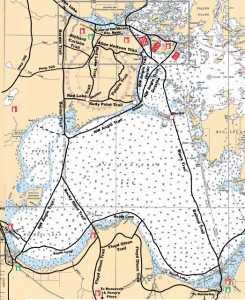
Every year, Mother Nature dictates when conditions are right to start grooming the hundreds of miles of snowmobile trails across and around Lake of the Woods. Mother Nature has done her part and so have the area snowmobile clubs. Between checking ice conditions, cutting through fallen trees, fixing bridges, adding or replacing signage along the trail, marking the trail and constant grooming, the good folks who are members of the club have been busy. The great news is snowmobile trails on land and across the ice on Lake of the Woods are open!
There are two active snowmobile clubs around the lake. The Lake of the Woods Drifters and the NW Angle Edge Riders. Both do a great job of maintaining and grooming trails and keep conditions up to date on their Facebook pages.
There are literally hundreds of miles of lightly used snowmobile trails throughout the area. Whether it is on the south of the lake through the miles of beautiful woods or up to the NW Angle, a 42 mile ride up to the Angle resort area, there is great trail riding available in the area.
Ice fishing is so good and well known throughout Lake of the Woods, snowmobiling takes a back seat. In reality, the trail system, beauty and resources of area resorts are second to none and get very little use. A nice change of pace vs the cosmopolitan snowmobile areas with hundreds or even thousands of sleds.
Snowmobile up to the NW Angle! Recently, myself and a couple of friends had the chance to embark on this snowmobiling trek. It was something we wanted to do for a long time. With a busy schedule and also out of fairness, being a walleye nut, never made the time for. On this particular trip, we put that “woulda, coulda, shoulda” aside and took on the adventure. Bret Amundson of Prairie Sportsman and Jamie Dietman, avid outdoorsman from the Brainerd area joined me and we did it up right. Our adventure was featured on an episode of Prairie Sportsman which airs on Pioneer Public Television, TPT Minnesota, Lakeland Public TV and KSMQ in Austin and Rochester.
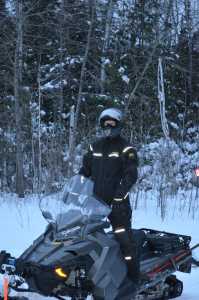
After spending a day snowmobiling the south end of the lake, we rode our Polaris sleds north across frozen Lake of the Woods to the NW Angle. The trail across the lake is about 42 miles long and marked with black stakes with reflectors on the top that show up well against the white icescape that extends as far as the eye can see.
The trail was in good shape, but it is important to stay on the trail as every year the ice freezes differently. The year we traveled north, the ice froze amongst crazy winds which caused ice upheavals scattered across the lake. Consequently, the trail snaked through what could be very dangerous ice chunks if not careful about sticking to the marked trail. As a rule of thumb each and every year, if you stick to the trail, it is all good and the snowmobiling is very beautiful.
Upon crossing Pine Island, the many fish houses come into view. This is prime walleye fishing area and the lake was covered with well distanced fish houses. After flying a drone to capture the scene the next stop was Garden Island.
Upon crossing the easterly tip of Garden, we stopped to check out the shelter on the island. The shelter is a refuge for all seasons if caught on the big lake in inclement weather. After a brief stop, we continued on to our destination, which on this trip, was Sportsman’s Oak Island. Chi chi and crew welcomed us and got us settled.
There are about twelve resorts up at the NW Angle and eight are open throughout the winter months. Some are on the mainland while other are on the islands. All are amongst the beauty of the Angle.
After lunch, we headed for the one room school house. Here, we met up with the President of the NW Angle Edge Riders, Richard Allen McKeever for an afternoon ride. We went west on the inlet to about the northernmost point of the contiguous United States possible, eventually entering the land trails and and then headed south just inside the Minnesota border along the Canadian line.
The trails were groomed to perfection with no traffic. We snowmobiled an entire afternoon and never saw another sled. “This happens all of the time,” explained McKeever. “Folks who have never snowmobiled the Angle hit the trails and are blown away at how well they are maintained, how wide they are and the absolute beauty of the NW Angle. They also comment on how little traffic there is on the trails.”
We agreed. The snow covered pines mixed with hardwoods were awe inspiring. This was postcard beauty at it’s finest.
We talked about how wonderful the sledding was in this area and how it was such a well kept secret. It’s no surprise snowmobiling in this area takes second fiddle to walleye fishing.
We did take part in some ice fishing our third day. I will say, the temps dropped to -25, so having a bombardier pick us up at the door of our cabin was a welcomed treat. The heated bomber drove us just a couple of miles to our heated fish house set up on the edge of one of the many NW Angle reefs. Despite the cold snap, Lake of the Woods once again produced. In a partial day of fishing, we caught plenty of fish for a fish fry that evening. Along with walleyes and saugers, we iced a tulibee, eelpout and jumbo perch.
If you like snowmobiling, a destination on your list needs to be Lake of the Woods. The two snowmobile clubs, the Lake of the Woods Drifters in the south and the NW Angle Edge Riders on the north end of the lake, are active and do a great job of maintaining the trails. The trails go through some of the most breathtaking natural landscapes around.
There are seven shelters along the trails to stop and take a break. These, for many, are nice places to stop, talk about the trails, plan on next stops and just pause for a moment to appreciate the beauty of being in the woods.
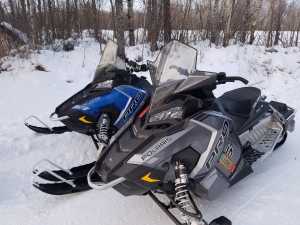
The sleds we used on this trip were all Polaris. It is something to see how Polaris, located in nearby Roseau, MN has evolved to make some of the best snowmobiles in the world. The sleds started right up in -25 temps, were snappy and powerful, hugged the trails beautifully and were very easy on the body. After putting on a couple of hundred miles in a few days, take it from a guy who doesn’t snowmobile much, I felt better than I ever had after so many miles. A testament to the new design and cutting edge suspension Polaris has incorporated.
The last day of our trip, we woke up to frigid temps bottoming out at -25. After a hearty breakfast and some good coffee in the lodge, we dressed up with extra cold weather gear, double checked that we had no skin exposed and fired up our sleds for the 42 mile journey to the south shore.
As the weather was extreme, we stopped every ten miles to make sure everyone was doing OK. It was nice having new sleds and having four of us in the event there was any equipment challenges. Luckily, there was not and we arrived to our trucks and snowmobile trailer in good shape.
This trip was unique as we focused on snowmobiling, something most don’t do on Lake of the Woods. I can promise you this, the trails were incredible. It was a trip we will never forget and one we will surely be embarking on again in the near future.
Thanks to the ongoing U.S.-Canada border closure to nonessential travel, getting to the Northwest Angle by road – which requires traveling about 40 miles through Manitoba – hasn’t been an option for anyone but permanent residents and essential workers since March 1.
The story of Lake of the Woods during the COVID-19 pandemic in many ways is a tale of two lakes. It’s a story of winners and losers.
The winners can be found along the south shore of Lake of the Woods, where tourism flourished once Minnesota Gov. Tim Walz lifted stay-at-home restrictions in late May, and people began satisfying their appetites to get outside for a taste of normalcy – or at least something resembling normalcy.
Like Lake of the Woods on a windy day, the season got off to a rocky start, but it rebounded nicely once the figurative waves settled, according to Joe Henry, executive director of Lake of the Woods Tourism.
“People as a rule, they wanted to social-distance, they wanted to get out and be outdoors,” Henry said. “Fishing was a very popular sport, and they wanted to get out of the metro areas, so Lake of the Woods was a very natural destination. “So, consequently, on the south end of the lake, our resorts (did) quite well this summer.”
Grand Forks Herald reporters and photographers/videographers traveled to Lancaster, Roseau, Warroad and the Lake of the Woods area in northwest Minnesota this fall to document the challenges the tourism industry and other businesses in the region have faced during the pandemic. What the Herald found is that some in the region have struggled, or had to adjust and adapt, due to the border closure. Meanwhile, some businesses there were seeing upticks in business as summer turned to autumn.
Three areas of Lake of the Woods
Tough times up north
The plot took a twist up at the Northwest Angle, that oddity of Minnesota geography surrounded on three sides by Canada and accessible from the U.S. only by crossing the lake. Thanks to the ongoing U.S.-Canada border closure to nonessential travel, getting to the Northwest Angle by road – which requires traveling about 40 miles through Manitoba – hasn’t been an option for anyone but permanent residents and essential workers since March.
As a result, the Angle – and its myriad scenic islands and sheltered bays – has only been reachable by crossing some 40 miles of windswept lake, a dangerous proposition for all but the most experienced boaters.
It’s even farther to reach resorts at Young’s Bay and Angle Inlet on the Northwest Angle mainland.
Minnesota’s Northwest Angle, south shore and Rainy River, all destinations served by Lake of the Woods Tourism. (Map courtesy of Lake of the Woods Tourism)
“We are a 100% tourism-based economy,” said Paul Colson, a third-generation owner of Jake’s Northwest Angle Resort on the Northwest Angle mainland with his wife, Karen. “That’s what we are, is all tourism, so we’ve essentially been on lockdown since March, when the Canadians closed the border to us.”
In a classic case of necessity being the mother of invention, plans are in place for an ice road this winter from Springsteel Resort near Warroad, Minn., to the Northwest Angle on a route that will follow both the lake and a trail cut through the trees on the U.S.-Canada border. That will help salvage the winter season, but without vehicle access all summer, it’s been a tough go for the dozen or so resorts on the mainland and nearby Flag and Oak islands.
“People are frustrated; they’re angry,” Colson said. “I feel like this summer was stolen from us.”
Caught in the middle
Efforts by Minnesota’s congressional delegation, including Rep. Collin Peterson and Sens. Amy Klobuchar and Tina Smith, among others, to reach out to Canadian government officials in hopes of allowing Angle-bound visitors to cross the border and access Manitoba roads, haven’t been successful, Lake of the Woods Tourism’s Henry said.
“The Northwest Angle is such a beautiful spot, but it’s caught between two countries, and it’s also caught between the politics of two countries,” Henry said. “I’ve been in close contact with many of our federal representatives, and they all have been reaching out to Canadian counterparts trying to create some kind of access, but nobody wants to touch it from Canada, and it certainly seems that nothing is going to change there for the time being.”
Jake’s Northwest Angle Resort didn’t have its first guests in camp until July 29, and the resort’s total lodging tax revenue for May, June and July was a mere $2.25, Colson said. Lodging revenue from May through September at the resort was down 83% from the same period in 2019, he said.
All because longtime guests with reservations on the books couldn’t drive to the resort.
“This would have been the best June I ever had in my life,” Colson said. “And now, I had zero people in May, June and almost all of July. I’ve had basically a week’s worth of business.”
The docks at Jake’s Northwest Angle Resort on the Angle mainland were all but empty Labor Day weekend, normally one of the busiest weekends of the summer. (Photo courtesy of Jake’s Northwest Angle Resort)
As bad as that sounds, Colson says he and his wife at least are in a position to survive this year financially. Their three kids are grown up, and he only makes improvements to the resort when he has the capital to do so.
“We know our existence is pretty tenuous here, so that’s kind of built into our brains, and we don’t overextend,” Colson said. “So for us, I’m 50 years old. How much money does it take for me to generate to survive? Well, if I had three kids at home and was looking at them going to college and having a resort payment? Oh my goodness.
“I don’t know how you do it. I guess you have a really good relationship with your bank.”
Further frustration
Trying to get a firm answer from the Canada Border Services Agency on what constitutes essential travel has been equally frustrating, Colson says. As an example, Colson said he asked one CBSA official whether a mechanic could travel to the Angle to fix a vehicle and was told that would be essential. Only to be told by another CBSA officer that it wasn’t.
The Herald on three occasions in October tried without success to reach the Northwest Angle. First, a Canadian border agent said travel by road wouldn’t be allowed because media weren’t deemed essential and could do their work by phone or internet; wind and an early freeze-up prevented two efforts to get there by boat.
Meanwhile, a crew of workers was able to drive to the Angle to put in a dock at a private cabin just down from the resort, Colson said.
“We’ve learned the key words are ‘deemed essential,’ because I can’t even get a real answer on what’s essential,” Colson said. “Having a guy come in and put in a dock, is that essential? No! Not in my mind.
“I keep saying, ‘Look, you show me the science that anybody’s ever been exposed (to COVID-19) by a passing vehicle,’” Colson said. “Essential travel for us is tourism.”
It’s not like businesses at the Angle want the Canadian border to open, he says; all they’re asking for is right of transit.
“We just want Americans to be able to drive from America to America,” Colson said.
‘Frustrated to desperate’
An unsettled mindset also lingered up at the Northwest Angle. Ed Arnesen, a Lake of the Woods County commissioner who represents the Northwest Angle – “the most northerly district in the United States other than Alaska,” he says – describes the mood among business owners up at the Angle as “frustrated to desperate.”
Ed Arnesen, a Lake of the Woods County commissioner representing the Northwest Angle and owner of Arnesen’s Rocky Point Resort on the south shore of Lake of the Woods, talks about the summer season on the two sides of the lake in early October inside the resort’s Rock Harbor Lodge. (Photo/ Eric Hylden, Grand Forks Herald)
“It seems like the farther west you go in Angle Inlet, the worse it gets,” Arnesen said. “Distance-wise, it’s just hard for people to get up there across the big lake with smaller boats. A lot of the people that fish up there have smaller boats than we do on the south end of the lake because they usually trailer them up, and it’s more protected water.
“So, it’s kind of a double-whammy for them.”
Arnesen, a third-generation resident of the Rocky Point area and owner of Arnesen’s Rocky Point Resort north of Roosevelt, Minn., said the resort on the south shore of Lake of the Woods had to shut down its busy winter season two weeks early when the pandemic descended in mid-March and didn’t reopen until June 10.
After that, people flocked to the south shore of the big lake.
“The summer was good on this side of the lake – very busy,” Arnesen said. “I think on the south end of the lake, it’s been busier than normal. Unfortunately, on the Northwest Angle and Islands, it’s been slower because of the border restrictions.”
Pulling the plug
It’s been even tougher for operators who own fishing camps in Canada. Gary Moeller and Nick Anthony, partners in Ballard’s Resort near Baudette, Minn., also own Ballard’s Black Island, a fishing camp on the Ontario side of Lake of the Woods.
The owners of the camp, which relies exclusively on American tourists, decided to cancel the season in July when it became apparent there would be no end to the border closure extensions, which continue to be implemented a few weeks at a time.
“It was super frustrating for us, not knowing,” Moeller said. “Obviously, they’re dealing with the entire border, but to just continue to extend it a few weeks at a time and a few weeks at a time and a few weeks at a time just created a scheduling nightmare for us.
“You’re on the phone nonstop, people always wanting to know, ‘What have you heard? What do you know? What’s going on?’ And we never had an answer for it. So finally, in July, we decided just to call it. It was fairly predictable at that point.”
Neither Moeller nor Anthony have been to the Ontario camp since the border closed but have Canadian contacts who mowed the lawn and kept an eye on the place. Crossing into Canada would have required filling out “a 40-page document or something like that,” Anthony said, along with spending 14 days in quarantine.
“Quite honestly, we haven’t even looked at it,” Anthony said. Not being able to offer the experience available on the Ontario side of the lake, which is drastically different from the open expanse of Minnesota waters, has been frustrating, he said.
At least, the partners say, they’ve had the American resort to fall back on during the border closure, and business on the south end of the lake has been brisk.
“It’s unfortunate, overall, for all of northwest Ontario because we/they were receiving next to no support from the government at all,” Moeller said. “It’s as though northwest Ontario doesn’t even exist right now, and it’s super frustrating financially. We’re obviously fortunate because we have another business that we can continue with, but a lot of our friends, that’s their sole income.
“It’s dire straits for a lot of them.”
Summer surge
In some ways, Moeller said, the brisk traffic on the south shore of Lake of the Woods this past summer was a surprise.
“I think we had a feeling early on that with the border being closed, we’d see a surge of fishermen that just wanted to get out and go,” Moeller said. “I think the biggest surprise for me was seeing the amount of resident fishermen that came up this summer.”
Normally, Minnesota residents make up about 25% of the summer clientele at Ballard’s, Moeller said. This year, 52% of the resort’s summer reservations came from Minnesota.
“Actually, for me, it was nice to see so many families, (and) you just know the reason they’re finally able to come to Lake of the Woods is because Timmy doesn’t have Little League, and Suzie isn’t in basketball camp somewhere,” Moeller said. “They actually had time, and I think they wanted to stay in-state and they wanted to do something fun, and so, hopefully, maybe we’ll get some long-term business out of the people that were from Minnesota but first-time ever to Lake of the Woods.”
On the other end of the lake, Colson, of Jake’s Northwest Angle, says he just wants his regular customers back. “We’ve got a great clientele. I think we’ll be fine,” Colson said. “It depends on how long this goes on. When does this end? Are we talking this winter? Next summer – is that in jeopardy, too? Can you go a couple of years?”
Colson says he just wants to run a resort without the drama that’s been thrust upon his and other businesses at the Northwest Angle because of Canada’s border-crossing restrictions.
“You show me a map where everybody has just been clobbered,” Colson said. “There is no place like this that’s been hit this hard. I look around, and it’s been all for nothing.
“The Northwest Angle is truly looking forward to this ice season where people can cross the lake on hard water finally. Look these folks up on the web and plan a trip to the northernmost part of the contiguous United States.
88 year old “Ike” Eichman and his friend Dan Ethan have been ice fishing together on Lake of the Woods for about 15 years. They are good friends who worked together in Ethan’s sheet metal company in the Twin Cities. Their tradition of ice fishing together has created a lot of memories, but this week’s ice fishing and a big walleye that left Ike shaking is at the top of the list.
“I was using my special pink jig and a live minnow. When I set the hook, I knew it was a big fish. At first, I was thinking it was a dogfish,” explains Eichman who is a Korean War veteran. “I fought it a long time. When I got it up to the hole, wait till you hear this story, Dan does a better job telling it. Dan tell him about it,” Ike says to his buddy with a big grin.
“Ike got it up to the hole and we saw it was a big walleye. He couldn’t get it’s head turned up the hole. As he was trying to get it’s head up the hole, the line broke,” explains Ethan. “Our hearts just sank. And then, Ike’s second rod started to bend. We soon realized the walleye had gotten the line that broke tangled up during the fight with the line from Ike’s second rod.”
“Now we really had a mess, but the big walleye was still hooked up just below the ice. As we looked down, the fish was so big, the tail of the walleye was stretched over just below the ice in the original hole,” explained Ethen with Ike grinning as the events were shared.
“I reached down and grabbed the tail. I was worried that when I touched the tail of that big walleye, it would kick like they often do when you touch their tail. This one didn’t. I grabbed the tail and started to pull it backwards up the hole. I told Ike it was starting to slip and just then I was able to get a better hold of the fish and pull it up through the hole backwards. “
“At first when the line broke, I was more worried about my special pink jig than the fish!” explained Ike. I have had that special jig for years and caught so many fish on it. When Dan got that huge walleye up the hole backwards, I didn’t see my jig at first. And then there it was. I said ‘there’s my jig’.”
Ike’s big walleye was 30.5 inches to be exact. “It was at that point I really had the chance to focus on how big this walleye was. I didn’t get the shakes until it was all over. I didn’t shake at all while I was fighting the fish. My previous largest walleye was 26.5 inches long also caught on Lake of the Woods. This was a lot bigger. It was such a beautiful fish,” Ike explained with a twinkle in his eye.
“We took a picture of Ike with his big walleye and released her back. She was healthy, in fact, when she kicked, that big tail gave me a shower!” explained Ike’s long time fishing buddy.
Ike and Dan were ice fishing through a Lake of the Woods resort. Resorts have fish houses out in some of the best fishing areas of Lake of the Woods, following walleyes and saugers throughout the winter. Many enjoy the ease of stepping into a spacious, heated fish house with the holes all drilled and cleaned out. Ice guides check on guests throughout the day making sure things are going well. At the end of the day, guides will even clean the fish. In many cases, area resorts will actually cook up your fresh catch.
Traditions. Friendships. Memories. Ice fishing is about so much more than just the fishing. And to think it all started out with that small pink jig.
There is much to do when visiting Lake of the Woods! The obvious, fishing, hunting and snowmobiling. The less obvious but equally as enjoyable are cross-country skiing and snowshoeing. Whether you’re a pro or just getting started, Lake of the Woods has miles of breathtakingly beautiful trails that wind through scenic areas of vast stands of pine, spruce and birch trees. Some slopping hills and curved routes are simple yet joyful enough for any skier new or seasoned.
Cross Country Skiing and snowshoeing have long been known to be one of the most healthy and beneficial sports. It can be enjoyed by people of all ages and fitness levels and can be purely recreational or highly aggressive and competitive. But what makes it the ultimate form of exercise is the fact that it is a total body workout and the ultimate calorie burner. Read on to learn all about the physical and mental benefits of cross-country skiing and next time you’re in Lake of the Woods try it out!
The Total Body Workout:
Few sports and activities can claim to be a total body workout, but cross-country skiing and snowshoeing is just that. It combines both a lower body and upper body workout, while simultaneously working both the “pulling” and “pushing” muscles of each region. Every major muscle group is involved in propelling forward, and even muscles that don’t seem to be in use are actively involved to balance and coordinate the entire body.
Both activities have proved to be so advantageous over other forms of aerobic exercise, that an entire brand of exercise equipment was designed using the same motion. And yet nothing can provide as holistic and balanced a workout as getting outside, into the snow, and onto a pair of cross-country skis or snowshoes.
Cross Country Skiing at Zippel Bay State Park
A Healthy Heart and Lungs:
Skiing and snowshoeing are an excellent aerobic workout, and because no single muscle group is overstressed, the activity can be sustained for hours on end. As a result, a fast heart rate is also sustained for a long duration. This sustained rapid heart-rate is exactly what your heart needs in order to be strengthened and to improve your heart’s capacity to pump blood efficiently and effectively.
Additionally, the sunlight absorbed through the skin while skiing is often the only natural source of Vitamin D during the winter months. Sufficient Vitamin D is necessary for the prevention of coronary disease, peripheral artery disease (PAD), and hypertension (high blood pressure), as well as maintaining strong bones.
A Low Impact Workout for Exceptional Joint Health:
Most sports and exercises carry the risk of damaging joints and ligaments from overuse, over-extension, and inevitable accidents. If this were not so, then the specialty of “Sports Medicine” would not need to exist. Unfortunately, most activities that strengthen one part of the body also tear down another. Fortunately, cross-country skiing –diagonal or classic skiing in particular– is one of the safest and lowest-impact sports in the world.
Unlike running sports, there is a very little shock to the feet, knees and hips thanks to the gliding motion of classic/diagonal skiing. Cross-country skiing is a relatively unidirectional sport, with very little rapid twisting and torquing, and therefore is far less likely than sports such as basketball, football, and volleyball to cause a pulled muscle, torn ligaments and cartilage, or hemorrhaged disks.
17.6km 218-783-6252 (P, B) 14.4km groomed trail ranging from beginner to intermediate near Lake of the Woods. Catch glimpses of timber wolves and deer. MN ski pass required.
The Lake of the Woods School also has a 2-mile snowshoe trail marked right off their parking lot. Beginners and families love to use this simple and easy to maneuver trail.
Ski pass information
All cross-country skiers on ski trails in State Parks or Forests, or on State or Grant-in-Aid Trails, who are aged 16 and above, must have a Minnesota Ski Pass. You must sign your ski pass and carry it with you when skiing. Your ski pass fee helps support Minnesota’s cross-country ski trail system.
Ski pass rates
Daily ski pass: $10
One-season ski pass: $25
(effective from one winter season to the next)
Purchasing a ski pass
Minnesota State Parks:
You will be able to purchase a daily pass in person at most parks. Self-registration for daily, annual and three-year ski passes will be available in parks with ski trails this winter. A mail-in envelope and an application will be provided for the purchaser. Payment or credit card information, along with a signature and personal information, will be required from the purchaser. The purchaser will retain a receipt until the ski pass arrives in the mail.
By phone
Call 1-888-MNLICENse (1-888-665-4236) to buy a daily, one-season, or three-season ski pass. It’s instant and easy. Have your date of birth, driver’s license and credit card (Discover, MasterCard or Visa) ready when you call. (There is a $3.50 processing fee for this convenience.)
Zippel Bay State Park is available at the following address
3684 54th Ave NW
Williams, MN 56686
Or call ahead at 218-783-6252
The Northwest Angle. It is the northernmost point of the contiguous United States, it is where the 14,552 islands of Lake of the Woods begin, it has 12 resorts who cater to anglers and the area is full of walleyes. Ice fishing is awesome on this part of the lake, but with the the border being closed, travel to the Angle has been challenging at best. This winter, visitors looking to travel to the NW Angle have a few options and one of them includes a fly in service. That’s right, land right on the ice near your favorite NW Angle resort.
During a normal winter, guests who enjoy ice fishing up at the Angle would simply drive through Canada and then enter back into the U.S. up at the Angle. With the pandemic and border being shut since mid March, 2020, travel up has been limited to traveling across the lake.
Another typical way some travel to the Angle during the winter months is snowmobile. The two snowmobile clubs around Lake of the Woods do an excellent job of grooming and staking trails from the south end of Lake of the Woods all the way up to the NW Angle. One trails comes out of the Wheeler’s Point area. When the ice is thick enough on the Rainy River, guests could literally take the trail all the way from Baudette to the Angle. The other route takes guests along the western edge of Lake of the Woods from the Rocky Point, Long Point area or from Warroad north.
There is now another option, flying. Lake Country Air out of Duluth, MN is now offering Fly In Fishing trips to the NW Angle. Currently, travelers can fly out of a variety of MN locations including Duluth, Baudette, Warroad, International Falls or Thief River Falls. Round trip flights will land you on the ice up at the NW Angle where you can access your favorite resort.
Lake Country Air offers both sight seeing tours and a charter service. The airplane used to fly into the Angle, interestingly enough, is no stranger to the Angle. “20 years ago had this plane up to Lake of the Woods,” explains Jesse Starkson, one of the owners. “They used to fly regularly to the Angle from Warroad. The flight service was very popular to many.”
The current plane being used is a Beaver and can transport 4-6 people based on weight.
This fly in service can fly anglers up to the NW Angle landing on the ice on specially prepared landing strips. This makes it possible for guests to access or get picked up by their favorite NW Angle resort.
The fly in service will also operate in the open water months. By May, the company will have a larger plane available called a Caravan which has longer range and can transport more than 10 people.
NW Angle resorts offer some of the best full service ice fishing in North America. Heated fish houses are moved often to keep you on the fish. Anglers will catch walleyes, saugers, jumbo perch, eelpout, pike, and tulibees. Once in a while, crappies, a muskie or a sturgeon will even make an appearance.
Angle resorts offer both great cooking facilities in their cabins or a number of them have a great bar and restaurant as part of their offerings. You might be way up north, but don’t for a minute think you will be sacrificing good meals. The menu offerings in these parts are plentiful and the food is delicious.
When you are staying at the Angle, whether you cook it yourself or let the resort cook it, fresh walleye with all of the trimmings is a tradition that is hard to beat.
Ice fishing the NW Angle is something special. With this year adding many challenges to our lives, please know that special place to allow relaxation, peace and calming is accessible, just maybe in ways we are not used to.
When Barb Carey joined AGLOW (Association of Great Lakes Outdoor Writers) seven years ago, something became very evident. Women were not being represented enough
throughout the ice fishing industry. “I had been running WI Women Fish since 2006 and I knew how many women actually ice fished. There were a lot. I also knew how much money women spent on the sport of ice fishing,” explained Carey. Those observations are what motivated Carey to start an organization called Women on Ice.
Women on Ice… To inspire and motivate other women who want to learn the sport of ice fishing, as well as generate awareness and recognition for women anglers. This movement of women ice anglers started seven years ago and has been building. “Awareness of women in the sport of ice fishing has gotten much better,” explains Carey, a retired police officer from Madison, WI.
Prior to being a police officer, Carey owned a petting zoo at one point in her life and was an LPN at a VA Hospital in the Upper Peninsula of Michigan. “It’s funny, I have helped more people through my fishing career than I had in all of my previous careers combined.”
Carey and other leaders from Women on Ice were up at Lake of the Woods this past week. It was mainly a work trip, gaining assets for sponsors, another way of saying providing images and videos, along with getting the word out about the benefits of the product lines they represent. Make no bones about it, along with the work, there was some fun, which includes ice fishing. “Normally at this event, we would invite women who would like to join us to learn more about ice fishing or simply get to know other women who ice fish. Because of COVID, we had to hold off on that part of the event,” explained Carey.
The Women on Ice event was based out of River Bend Resort located at the mouth of the Rainy River that leads into Lake of the Woods. This was home base where the ladies were staying in cabins overlooking the river and across the ice to Canada.
As a guest at the Women on Ice event, my main role was to stay out of the way! These ladies are proficient with a capital “P”! These ladies came with their own ice transportation. A couple brought snowmobiles, others brought ATV’s. In many cases, these ice fishing machines were tricked out with features making ice fishing easier and more enjoyable.
I rode with Carey on her red Honda ATV. It was set up with a Raymarine GPS so Carey knew exactly where she was both on land and on the ice. It also allows her to follow her plot line to and from fishing spots on the ice making sure she didn’t get off course.
For the ladies who didn’t have a unit on their sled or ATV, Carey insisted they use their Navionics app in their Smartphone. At one point, just as the sun was rising and everyone was getting ready to hit the ice, Carey pulled one of the group aside and asked her, “Do you have your Navionics on? Do you know how to drop a plot line so you can find your way back if need be?” It was all part of it, teaching, promoting leadership, enabling ladies with the skills and tools to be self sufficient as ice anglers.
When I say these Women on Ice ladies know their stuff, I mean it. Each morning they were out before the sun was up starting their machines, looking over their equipment, attaching their collapsible fish houses to their snowmobile or ATV.
At the end of the day, same routine in reverse. Some equipment was brought inside where it was warm, other equipment secured in trailers, etc.
When I rode with Carey, she pulled two collapsible fish houses, one attached to the other. Her K-Drill auger was attached to the front of her ATV. She made sure to take my Vexilar in a bucket and put that in the front rack. “With any electronics, I like to put them on the front rack so they don’t get so beat up in the fish house banging around.” There weren’t many details missed. Equipment was accounted for and secured.
The Women on Ice group was very good about helping each other out. “Are you topped off with gas? I have a gas can in the trailer, let me grab it for you.” This kind of teamwork resonated.
Naturally, some of the ladies had more experience than others, and it didn’t matter. What mattered is making sure everyone was safe, helping to accomplish the mission of the trip and having a good time.
The Women on Ice event was very organized with safety being of prime importance. “Can I have everyone’s attention.. Hey, can you guys turn your machines off just for a second, thank you. We are going to go out on the ice together. I will take the lead and Rikki, (referring to Rikki Pardun, one of the leaders) will be in the back. Let’s make sure we stay together in a line. This is still early ice and we have to be careful. If you would happen to come across an area or something that doesn’t look right, stop your machine and approach it on foot to check it out with a spud bar first. Make sure you have your float suits on and zipped up. Does everyone have ice picks on?”
Once on the ice, these ladies, if they weren’t involved in shooting a video or creating some cool looking still shots of ice fishing products, were after the walleyes. Once we stopped in an area, the augers were cutting ice, collapsible fish houses were being set up, heaters were getting started. Some of the ladies, simply to get their line in the water, started fishing in the open. All were dressed in Clam ice suits, one of the Women on Ice sponsors, so they were ready for the weather.
I have to say, the Women on Ice group needed nobody’s help, in fact, I am confident they could provide some good learning for the majority of ice anglers. If they did, they would be cool about it. These are a group of very good natured female ice anglers who simply love ice fishing, love the comradery, and love being ambassadors in a sport they hold near and dear to their hearts. Women on Ice, advancing the sport of ice fishing.
Ice fishing has begun on most areas of Lake of the Woods. Some resorts and outfitters were fishing last week, while others chose this week was better based on the ice conditions where they fish. Either way, this wonderful tradition so many look forward to is happening on Lake of the Woods.
Lake of the Woods is a big lake. Ice conditions can vary from area to area so it is important to work through a resort or outfitter. They keep a good eye on ice conditions on their ice road or trail which will help you understand where things are at.
It is also important to consider a few things that can improve your odds of a good trip…
Adhere to weight limits on the ice road you are using. When you are headed out ice fishing and a resort says snowmobiles, ATV’s and side by sides, it doesn’t mean a small SUV is appropriate. Not only can you endanger yourself, it can mess up the ice road for others which can slow the progression of a good ice road for everyone.
Keep speeds less than 15 mph. When you travel on ice, there is a wave that forms in front of your vehicle under the ice. This wave, at all times of the year, but especially during early ice, can really mess up the ice if you are traveling too fast. In addition to simple safety and the risk of accidents on top of the ice, the wave created underneath the ice is a good reason to slow down as well.
Stay on the marked trails. When someone gets into troubled ice, it is usually when they have ventured out on their own. Resorts and outfitters start marking trails early in the year, understanding where there are springs, cracks, ice upheavals along with important knowledge of where the ice formed evenly and is more thick.
Don’t Stay Out Late. On Lake of the Woods with it’s stained waters, the best ice fishing is during the day. If you able to come off of the lake at a reasonable hour when others are also traveling off of the lake sure helps if you get into any kind of trouble. We all want to get that last part of the golden hour (sunset) in, but be smart when considering traveling across the ice when nobody else is around.
Have a charged up cell phone with you. When you are out ice fishing, if you get stuck, your vehicle doesn’t start, etc, it is good to have a cell phone with you to call for help. Make sure it is charged up ahead of time. Many anglers will carry a remote battery to charge up their phone while on the ice.
Ice fishing has begun on Lake of the Woods. The fishing reports so far have been good and people are excited to get out. The resorts are doing a nice job of staying on fish. This time of year, it seems the walleyes start out a bit shallow and as traffic on the ice increases, they slowly make their way to deeper water.
Ice fishing is never a perfect science, but understanding fish patterns, how long to stay in a spot, when to move, etc is all part of the game.
As far as lures and techniques, the best strategy for ice fishing LOW is the old one-two punch. As you can have two lines during the Minnesota ice season, anglers will use one jigging line and one deadstick line. A jigging line is exactly that, a line you jig, such as a jigging spoon with a minnow head or maybe a noisy lure like a Rapala Rippin Rap. A deadstick is normally a live minnow on a jig or hook under a bobber about 6 inches off of the bottom. When the fish are active, they will hit the line you are jigging. When they are in a more neutral mood, the line with a live minnow may get more attention.
As far as colors, this is stained water, consequently, gold, glow red, glow, orange and chartreuse are all good starts.
When you come up, work through a resort, exercise safety first and bring a good camera!




 When raising the bait in the water column, use your reel vs lifting your rod with your arms. If you have raised your arms up too high, you not only have nothing left to set the hook with, if you are fishing in a fish house with a lower roof, you will actually hit the roof of the fish house with the rod when you set the hook. Using your reel to control the depth of your lure will keep your arms in the best hook setting position.
There are times when a walleye or sauger will chase you way up and slowly drift back down to the bottom. Don’t get discouraged. Go after them again. Many times the walleye or sauger will respond numerous times before deciding to actually eat.
Good electronics for ice fishing helps tremendously in understanding how the fish are reacting. Learning what each walleye wants and how they want it is invaluable. I grew up using a Vexilar and wouldn’t give it up. Electronics are an important part of icing walleyes and gives ice anglers a big advantage.
Be Aggressive. There is a time to speed up and a time to slow down. Getting erratic and aggressive with search lures, swimming baits, vibration baits and larger spoons can trigger the eyes to eat. This might mean pounding the bottom, fast high lifts with uncontrolled drops, constant shaking and jigging higher up in the water column. Much like a crankbait, going after the reaction strike can trick walleyes into hitting your lure when a normal presentation would not work.
Chill Out. Of course, the opposite approach of targeting more neutral fish is to go more finesse. That might mean smaller lures, tipping your lures with smaller pieces of bait, less action while jigging or even setting your jigging line on a bucket simply watching for the rod tip to bend ever so ever slightly. Some very good ice anglers actually prefer watching their rod tip vs using a bobber as they feel it is easier to detect light biters. A subtle tweak during a tough bite will ice more walleyes.
Deadsticking. As much fun as it is jigging up a nice walleye, it is also fun being productive and catching as many fish as possible. This is why most ice anglers targeting walleyes will have down a deadstick, or a bobber line in addition to the jigging line.
When raising the bait in the water column, use your reel vs lifting your rod with your arms. If you have raised your arms up too high, you not only have nothing left to set the hook with, if you are fishing in a fish house with a lower roof, you will actually hit the roof of the fish house with the rod when you set the hook. Using your reel to control the depth of your lure will keep your arms in the best hook setting position.
There are times when a walleye or sauger will chase you way up and slowly drift back down to the bottom. Don’t get discouraged. Go after them again. Many times the walleye or sauger will respond numerous times before deciding to actually eat.
Good electronics for ice fishing helps tremendously in understanding how the fish are reacting. Learning what each walleye wants and how they want it is invaluable. I grew up using a Vexilar and wouldn’t give it up. Electronics are an important part of icing walleyes and gives ice anglers a big advantage.
Be Aggressive. There is a time to speed up and a time to slow down. Getting erratic and aggressive with search lures, swimming baits, vibration baits and larger spoons can trigger the eyes to eat. This might mean pounding the bottom, fast high lifts with uncontrolled drops, constant shaking and jigging higher up in the water column. Much like a crankbait, going after the reaction strike can trick walleyes into hitting your lure when a normal presentation would not work.
Chill Out. Of course, the opposite approach of targeting more neutral fish is to go more finesse. That might mean smaller lures, tipping your lures with smaller pieces of bait, less action while jigging or even setting your jigging line on a bucket simply watching for the rod tip to bend ever so ever slightly. Some very good ice anglers actually prefer watching their rod tip vs using a bobber as they feel it is easier to detect light biters. A subtle tweak during a tough bite will ice more walleyes.
Deadsticking. As much fun as it is jigging up a nice walleye, it is also fun being productive and catching as many fish as possible. This is why most ice anglers targeting walleyes will have down a deadstick, or a bobber line in addition to the jigging line.